
Cantilever Gate Vs Roller Gate: Which Is Right For Commercial Sites?
Choosing between a cantilever gate and a roller gate affects more than curb appeal. It can determine how reliably your entrance operates year-round. Cantilever gates span the driveway without a ground rail, making them a strong choice for snow, gravel, mud, leaves, and uneven pavement. Roller or V-track gates run on a rail across the opening. They often cost less upfront but require a clean, level, well-maintained track.
The right option depends on your site conditions, gate size, traffic frequency, wind exposure, and available space along the fence. A cantilever gate needs room for a counterbalance, while a roller gate needs dependable drainage and regular track maintenance. Understanding these trade-offs helps you choose a gate that delivers lasting performance rather than simply the lowest initial price.
Key Takeaways
- Choose a cantilever gate for snow, gravel, mud, leaves, uneven or crowned pavement, and high-traffic entrances because it keeps the driveway clear of ground rails and debris.
- Choose a roller or V-track gate when the entrance is flat, clean, level, and well drained, with limited fence-line space for a cantilever counterbalance.
- Cantilever gates require more side clearance, structural support, and upfront investment, while roller gates require consistent track cleaning, drainage, alignment, and maintenance.
- Base the decision on opening width, traffic frequency, wind exposure, drainage, foundation conditions, automation duty cycle, maintenance capacity, and available space—not just initial cost.
Cantilever And Roller Gate Mechanics
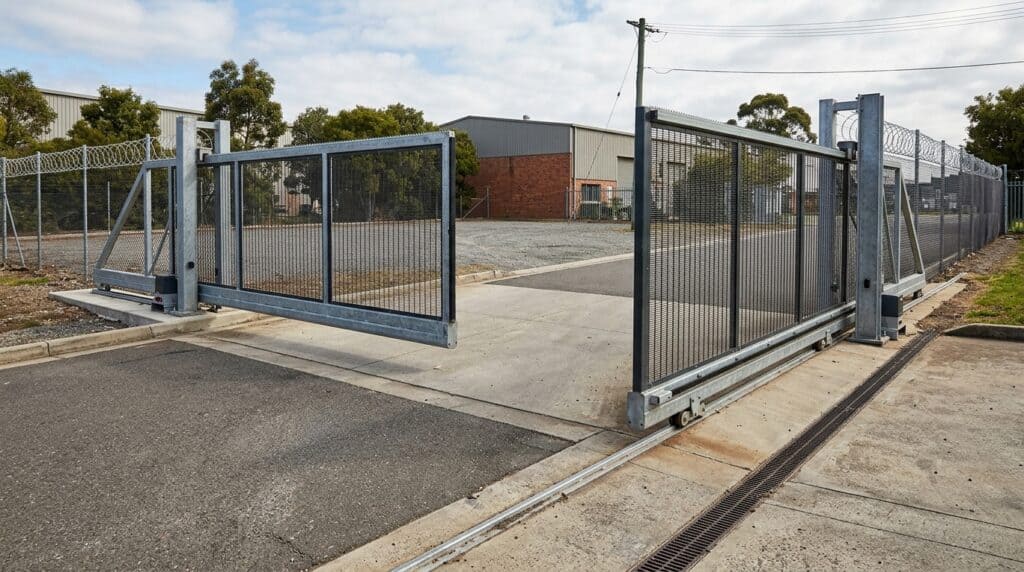
A cantilever gate moves by suspending the gate panel from roller carriages mounted to a reinforced foundation beside the opening. Its counterbalanced tail supports the panel as it travels, so no wheel or rail occupies the vehicle path. This design keeps the opening clear of snow, gravel, mud, leaves, and other debris that can interfere with ground hardware. It also performs well where pavement is crowned, uneven, or exposed to frequent commercial traffic. The trade-off is that the gate needs additional clearance along the fence line for its tail and typically requires a larger, carefully engineered foundation.
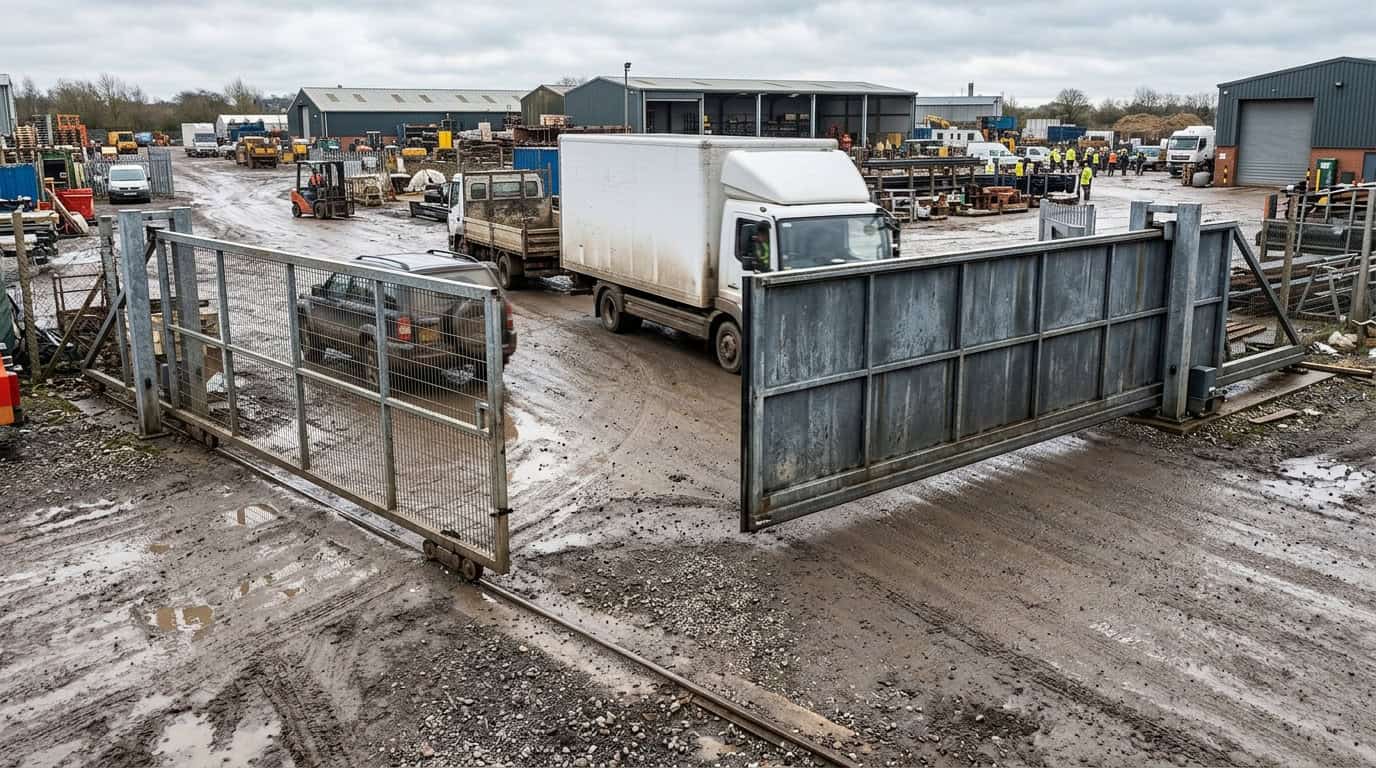
A roller gate, also called a ground-supported rolling or V-track gate, carries its weight on wheels that move along a rail installed across the driveway. Because the wheels depend on that rail, the track must remain level, continuous, well drained, and free of obstructions. Even small shifts in grade, debris buildup, or rail damage can affect movement and increase maintenance demands. Roller gates can be a practical choice for clean, flat sites where space for a cantilever counterbalance is limited. However, the ground track crosses the vehicle entrance, so it must be protected and maintained as part of normal site operations.
For commercial and industrial properties, the right choice depends on more than the initial equipment cost. A cantilever gate is generally better suited to snow-prone areas, gravel drives, uneven pavement, or high-cycle access points. A roller gate may fit a level, clean, well-drained entrance with limited side clearance. Gate size, wind exposure, traffic frequency, foundation quality, and local drainage should all be evaluated before selecting the mechanism. Neither system is automatically stronger, because performance depends on proper structural design, installation, and maintenance. A site-specific review can confirm which arrangement offers the most reliable operation for the terrain and access requirements.
Terrain And Traffic Performance
In a cantilever gate and roller gate comparison, terrain is one of the most important operational factors. Cantilever gates span the driveway without wheels or a track on the ground, so snow, gravel, mud, leaves, and standing water are less likely to block movement. They also avoid many problems caused by uneven pavement or crowned roads, where a ground rail can shift, collect debris, or lose alignment. This makes cantilever systems a strong choice for commercial entrances that must remain dependable through changing weather and site conditions.
Roller or V-track gates can perform effectively when the driveway is flat, clean, and well drained. Their ground-supported wheels can provide smooth, efficient movement when the rail remains clear and level, but routine sweeping, snow removal, drainage control, and track maintenance become part of reliable operation. Even small stones, packed mud, fallen leaves, or ice can interfere with the wheels and increase wear. For a low-traffic property with favorable surface conditions, a roller gate may offer a practical and economical solution.
High-cycle commercial entrances typically place a greater premium on consistent access than on the lowest initial installation cost. Cantilever hardware and foundations must still be correctly sized for the gate’s span, wind load, traffic cycles, and operating equipment, but the design removes a common obstruction from the opening itself. Roller gates may be suitable where the site has dependable drainage, disciplined maintenance, and limited space along the fence for a cantilever counterbalance. Evaluating surface conditions, seasonal exposure, and daily vehicle volume will help determine which system can deliver the required long-term reliability.
Installation Space And Structural Requirements
A cantilever gate needs clear fence-line space for its counterbalance, which travels behind the opening as the gate operates. The total gate length commonly measures roughly 1.5 times the clear opening, although the exact ratio depends on the hardware system, gate weight, wind exposure, and engineering specifications. Because the gate spans the driveway without a ground track, the opening remains free of rails that could collect gravel, mud, leaves, or snow. This design can suit uneven terrain and high-traffic sites, but it requires substantial support posts and properly engineered foundations to carry the suspended gate and operating forces.
A roller or V-track sliding gate requires a straight, level run-back area along the fence, generally close to the width of the clear opening. Its wheels travel on a track installed across the driveway, so the track base must be accurately aligned, securely anchored, well drained, and capable of remaining stable under repeated traffic and weather conditions. The gate typically needs less counterbalance space than a cantilever system, but vehicles, debris, ice, and pavement movement can affect track performance. Support posts and foundations must still be sized for the gate’s weight, wheel loads, operating cycles, and the forces transferred when the gate stops or reverses.
The required clear opening should be established first, then used to evaluate the available run-back, counterbalance zone, and structural capacity. Larger or heavier gates, wide openings, and locations with strong wind exposure may require deeper foundations, heavier posts, upgraded hardware, or additional engineering regardless of the mechanism selected. A roller gate may be practical when the site is flat, clean, and well drained, while a cantilever gate often provides more dependable operation where snow, gravel, mud, leaves, crowned pavement, or frequent traffic could obstruct a track. Reviewing these conditions with the gate’s intended weight and cycle frequency helps determine which system fits the terrain and commercial access requirements.
Cost, Maintenance, And Site Selection
Upfront cost is often the clearest advantage of a roller gate, because its wheels and V-track support the gate across the driveway rather than requiring a counterbalance frame. However, installation still depends on a precisely aligned rail, a stable foundation, and well-drained pavement, which can increase costs on uneven or settling sites. A cantilever gate typically requires more steel, stronger posts, and a larger concrete foundation, plus clear fence-line space for the counterbalance section. That higher initial investment can provide better long-term reliability where snow, gravel, mud, leaves, or crowned pavement would interfere with a ground track. Automation costs for either system depend on gate weight, travel distance, wind exposure, safety equipment, and the expected number of opening cycles.
Maintenance requirements also differ at the point where the gate carries its load. A roller gate needs regular track cleaning, wheel inspection, alignment checks, and debris removal because even small stones or packed dirt can disrupt movement. A cantilever gate keeps the opening clear of a bottom rail, reducing exposure to driveway debris and standing water, but its guide rollers, carriage assemblies, and structural hardware must still be inspected and lubricated as specified. High-cycle commercial or industrial sites should select heavy-duty components and an operator rated for the anticipated traffic rather than choosing equipment based only on gate size. Foundation quality matters for both designs, since settlement can cause binding, uneven travel, premature wheel wear, or automation faults.
For site selection, choose a cantilever gate when difficult terrain, severe weather exposure, frequent traffic, or dependable operation is more important than the lowest installation price. Select a roller or V-track gate when the driveway is flat, clean, well drained, and there is limited room along the fence for a cantilever gate’s counterbalance. Also confirm that the site can accommodate the required track, gate swing path, service access, and concrete work before approving the design. A professional comparison should weigh upfront installation, expected maintenance, debris exposure, foundation conditions, automation duty cycle, and available clearance together. This framework helps commercial and industrial owners match the gate mechanism to actual operating conditions instead of assuming either design is universally stronger or less expensive.
Cantilever vs Roller Gate: Which Fits Your Driveway?
In a cantilever gate and roller gate comparison, the key difference is how each gate is supported. A cantilever gate spans the driveway without a rail across the opening, so its moving components stay clear of snow, gravel, mud, leaves, drainage channels, and uneven pavement. A roller, or V-track sliding gate, uses wheels that travel along a ground-mounted rail, which can offer a more compact design where fence-line space is limited and the surface is flat, clean, and well drained. Cantilever systems typically require additional space beside the opening for the counterbalance, while roller gates may be more vulnerable to debris, ice, and track damage. Neither mechanism is automatically stronger, since performance also depends on the gate size, frame design, foundation, wind exposure, and operating hardware.
Commercial buyers should weigh opening width, traffic frequency, wind loads, drainage, surface conditions, maintenance capacity, and available installation space before selecting a system. A cantilever gate may suit a busy industrial entrance where dependable operation and minimal obstruction inside the opening are priorities, while a roller gate can be practical for a controlled site with regular track cleaning and limited room for a cantilever tail. Consider how often the gate will cycle, how quickly debris or standing water accumulates, and whether maintenance access will remain available throughout the gate’s service life. Requesting a professional site assessment, design, and quotation can confirm the required clearances, structural requirements, automation, and safety features for the property.
Frequently Asked Questions
1. What is the main difference between a cantilever gate and a roller gate?
A cantilever gate is suspended from roller carriages beside the driveway, so it moves without a ground rail across the opening. A roller gate, also called a V-track or ground-supported gate, carries its weight on wheels that travel along a rail installed across the entrance.
2. Which gate is better for snow, gravel, mud, and leaves?
A cantilever gate is generally the better choice because its operating hardware stays beside the driveway rather than in the vehicle path. Snow, gravel, mud, leaves, and other debris are less likely to block movement or damage the system.
3. When is a roller or V-track gate the better option?
A roller gate works well when you have a flat, clean, well-drained entrance and enough space for a continuous ground rail. It can also be a practical choice when the lower initial cost is important and you can commit to regular track cleaning and maintenance.
4. Which type of gate costs less to install?
Roller gates often cost less upfront because their design uses a ground rail and supporting wheels across the opening. Cantilever gates typically require reinforced roller-carriage foundations, a counterbalanced tail, and more structural planning, which can increase installation costs.
5. How much space does a cantilever gate need?
A cantilever gate needs additional clearance along the fence line for its counterbalance, commonly called the tail. The required space depends on the gate opening, frame design, weight, and hardware, so you should confirm the full travel and foundation layout before installation.
6. Which gate requires more maintenance?
A roller gate usually requires more frequent maintenance because its track must remain level, continuous, clean, and properly drained. A cantilever gate avoids ground-track debris, but its carriages, foundation, guide hardware, and counterbalance still need periodic inspection and lubrication.
7. Are cantilever gates better for uneven or crowned pavement?
Yes, cantilever gates are usually better suited to uneven, crowned, or shifting pavement because the gate does not depend on a rail installed across the driveway. Roller gates require a stable, level track, and changes in grade can cause binding, wheel wear, or unreliable operation.
8. Which gate is better for high-traffic or automated entrances?
A cantilever gate is often the stronger choice for high-traffic entrances because it keeps the vehicle path clear and is less vulnerable to track contamination. The best solution still depends on gate size, wind exposure, operating speed, automation requirements, and the quality of the supporting foundation.