
Choosing Between Cantilever Gates And Overhead Track Systems For Industrial Security
Securing a high-traffic perimeter requires a delicate balance between mechanical reliability and spatial efficiency. When evaluating a cantilever gate vs overhead system, the right choice often depends on specific terrain and height requirements. As automation technology moves toward integrated sensing, understanding the fundamental physical differences between these two designs is critical.
A cantilever system excels in harsh environments where snow or debris might obstruct ground tracks, utilizing a counterbalance to hover across the opening. Conversely, overhead gates offer a compact footprint for urban sites where lateral space is at a premium, provided the necessary vertical clearance is available. Selecting the ideal configuration ensures long-term operational safety while minimizing the frequency of maintenance interventions.
Key Takeaways
- Choose cantilever gates for sites with ample lateral room and harsh weather, as their trackless, counterbalance design prevents operational failures caused by snow, ice, or debris.
- Select overhead gate systems for urban or space-constrained environments to eliminate the need for a long counterbalance tail, provided the site can accommodate permanent vertical height restrictions.
- Prioritize cantilever systems to reduce long-term maintenance, as their protected, sealed rollers require less frequent intervention than the exposed trolley tracks and structural beams of overhead systems.
- Conduct a professional site survey to balance spatial trade-offs, ensuring the chosen hardware supports high-traffic automation without creating logistical bottlenecks for oversized vehicles.
Analyzing Lateral Counterbalance Requirements Versus Vertical Clearance Constraints
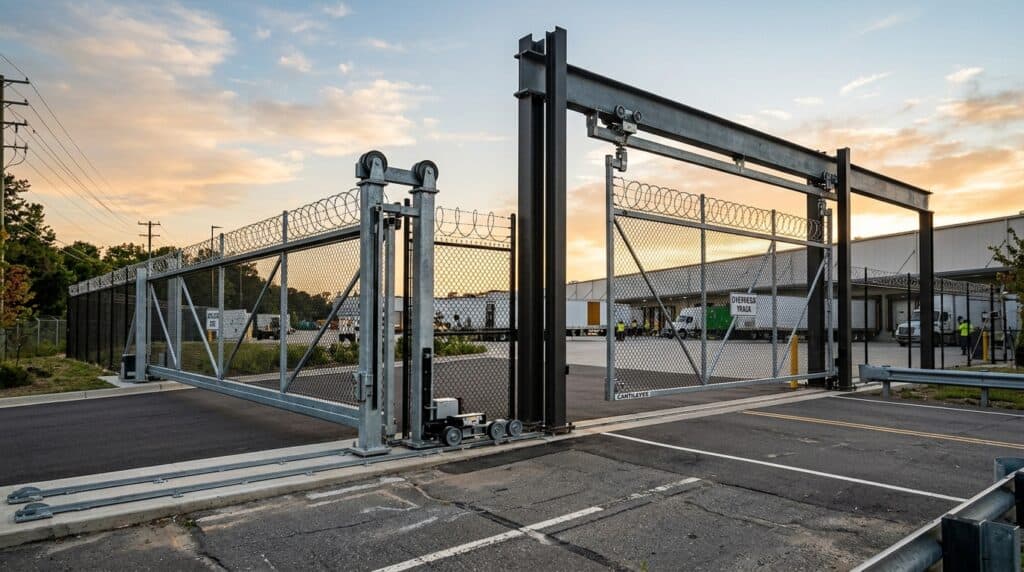
Selecting the ideal gate configuration for an industrial facility requires a precise evaluation of available square footage versus vertical accessibility needs. Cantilever gates are often the preferred choice for sites with unlimited lateral space, as they utilize a counterbalance tail section that typically extends fifty percent beyond the actual opening width. This design allows the gate to remain entirely suspended, making it an excellent solution for properties with uneven terrain or regions prone to heavy snow and debris. However, if a perimeter fence line is obstructed by existing structures or property boundaries, the significant side room required for the counterbalance may prove prohibitive.
Overhead gate systems provide a strategic alternative for high traffic commercial environments where lateral space is at a premium but vertical clearance is abundant. These systems operate along a fixed overhead beam, allowing the gate to slide open without the need for a lengthy tail section or extensive side room. While this footprint is highly efficient, facility managers must account for the maximum height of their tallest vehicles, including freight trucks and heavy machinery, to avoid collisions with the support structure. Modern installations are increasingly integrating automatic gate safety sensors to monitor these clearances in real time, ensuring that the overhead track does not become a bottleneck for logistics operations.
Determining which hardware configuration suits specific site constraints often necessitates a professional technical assessment to prevent long term operational issues. A cantilever system offers the benefit of lower maintenance due to fewer overhead components, yet it can be sidelined by a lack of horizontal clearance. Conversely, an overhead system maximizes ground level space but introduces permanent vertical height restrictions that could limit future equipment upgrades. Because every industrial property presents unique architectural challenges, a comprehensive site survey is the most effective way to analyze these spatial trade offs before investing in a permanent security solution.
Performance In Harsh Weather And Challenging Terrain Conditions
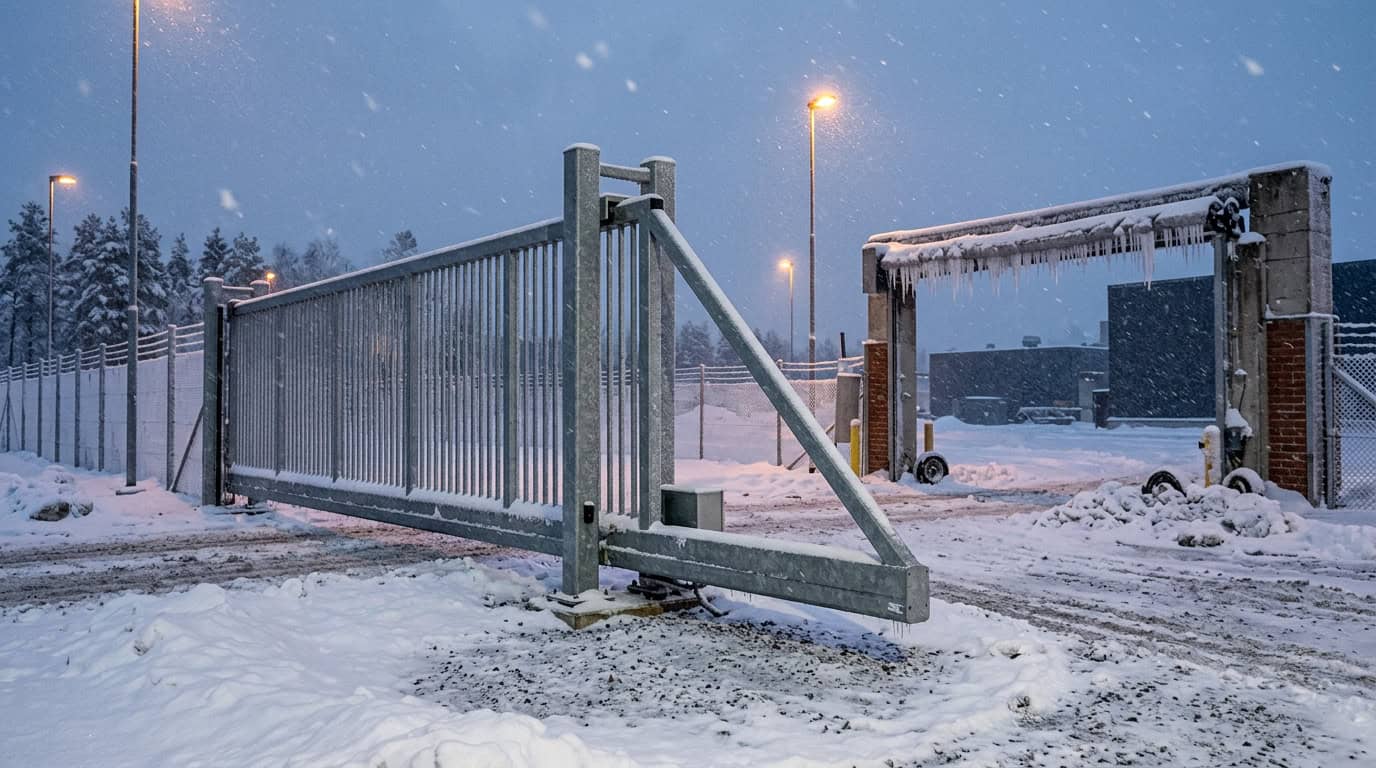
Selecting the right gate hardware for industrial sites requires a careful analysis of how local environmental stressors will impact long term operational reliability. Cantilever gates are often the superior choice for facilities dealing with heavy snowfall or unpaved gravel entrances because their trackless design eliminates ground contact entirely. Since the gate is suspended and moves via a counterbalance system, there is no risk of debris or ice buildup clogging a ground track and causing motor burnout. This mechanical isolation ensures that a security perimeter remains functional during the harshest winter months without the need for constant manual clearing. For commercial clients managing expansive yards or rural facilities, the cantilever system offers a low maintenance solution that thrives where ground conditions are unpredictable.
In contrast, overhead gates provide a specialized advantage for urban industrial sites where lateral space is at a premium and high wind stability is a priority. The permanent overhead beam acts as a structural guide that secures the gate at both the top and bottom, preventing the rattling or bowing that can occur with traditional gates during heavy gusts. This rigid configuration is particularly beneficial in high density city environments or coastal regions where wind tunnels between buildings can exert significant pressure on large gate panels. While these systems require specific vertical clearance for tall vehicles, the added stability of the overhead track ensures smooth, consistent movement in turbulent weather. Choosing between these two configurations ultimately depends on whether a facility faces the challenges of ground level obstructions or the structural demands of high wind zones.
Maintenance Cycles For Counterbalance Rollers And Overhead Trolley Tracks
Industrial facilities prioritizing reliability often gravitate toward cantilever gate systems due to their streamlined maintenance profiles. These gates utilize sealed counterbalance rollers that are engineered to withstand harsh environmental conditions without frequent maintenance interventions. Because the internal bearings are protected from grit, moisture, and debris, the primary service requirement involves simple periodic checks for structural alignment and hardware tension. This design is particularly advantageous for high-traffic commercial sites where downtime for lubrication or cleaning can disrupt essential logistics. Managers can typically expect these components to perform reliably for years before any significant mechanical overhaul is necessary.
Overhead track systems require a more hands-on approach to ensure long-term operational safety and smooth movement. The trolley tracks and rolling assemblies are exposed to the elements and must be regularly lubricated to prevent friction-related wear or motor strain. Maintenance crews must also perform routine inspections of the overhead structural beam to check for signs of fatigue, corrosion, or shifting caused by building settling. Since these gates are suspended above vehicle paths, verifying the integrity of the track mounting hardware is a critical safety protocol. Regular cleaning of the track channel is also essential to prevent the accumulation of dust or ice that could derail the trolley.
Selecting the right hardware configuration ultimately depends on a facility’s specific space constraints and the team’s capacity for ongoing upkeep. While cantilever gates offer an advantage regarding their rollers, they require substantial lateral clearance that may not be available on every property. Overhead gates solve the problem of limited side room but trade that convenience for a more rigorous inspection schedule involving height-access equipment. Understanding these distinct maintenance cycles allows facility directors to make an informed technical decision before requesting a professional site survey. Balancing the simplicity of sealed rollers against the structural demands of overhead tracks ensures perimeter security remains functional and cost-effective.
Selecting The Optimal Gate Hardware For High Traffic Automation
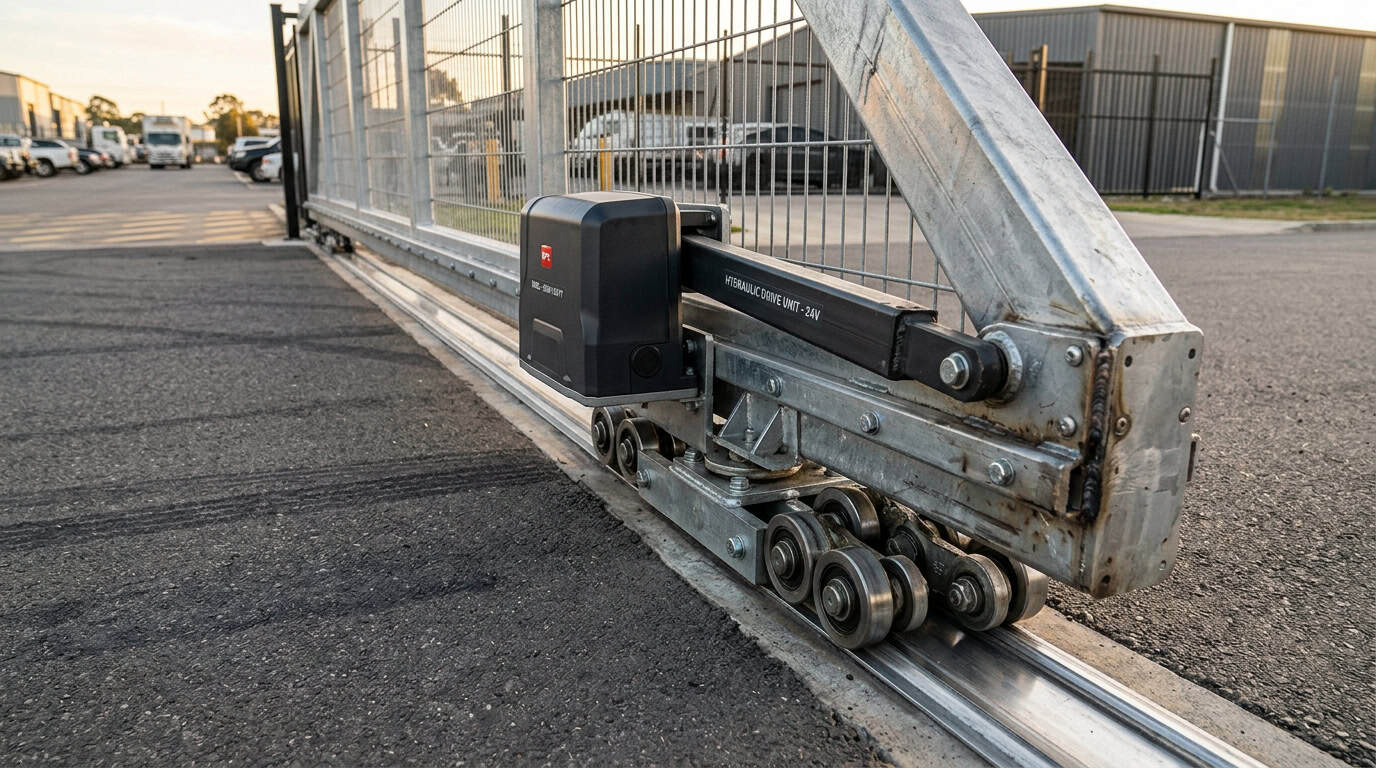
Selecting the right gate configuration for high traffic commercial environments requires a careful assessment of a facility’s physical footprint and throughput requirements. Cantilever gates are often the preferred choice for sites with ample lateral space, as they slide parallel to the fence line without requiring ground tracks that can become obstructed by debris or snow. This design minimizes mechanical wear during high frequency cycles, making it a reliable partner for rapid automation systems. Because the gate is suspended, it offers a smooth and consistent travel speed that is essential for synchronizing with security sensors. These sensors rely on predictable movement patterns to accurately distinguish between authorized vehicles and potential security breaches.
Overhead gate systems provide a specialized alternative for urban industrial sites where lateral clearance is restricted. By utilizing a permanent overhead beam to support the gate weight, these systems eliminate the need for the large counterbalance tail required by cantilever designs. This configuration is particularly effective for narrow entryways that must maintain high security while accommodating heavy vehicle traffic. Modern overhead hardware is engineered to integrate seamlessly with smart controllers, allowing for precision braking and acceleration that protects the longevity of the motor. When paired with advanced analytics, overhead gates can be programmed to trigger specific lighting or camera presets the moment the gate reaches its vertical or horizontal limit.
Determining which hardware configuration will best serve long term operational goals involves a detailed analysis of site topography and traffic volume. While cantilever gates offer lower maintenance requirements in harsh weather, overhead systems maximize usable square footage in tight quarters. Both systems now feature advanced connectivity options that allow for real time monitoring of hardware health and cycle counts through centralized security dashboards. Investing in the correct mechanical foundation ensures that an automated entry point remains a fluid part of the logistics chain. The Future Of Commercial Gate Access Systems and unified entry security relies on selecting hardware that supports the fastest possible cycle times.
Choosing Between Cantilever and Overhead Gates
Selecting between a cantilever gate and an overhead system requires a careful evaluation of a facility’s physical footprint and operational environment. Cantilever gates are a primary choice for sites with ample lateral room along the fence line, as they utilize a counterbalance design that eliminates the need for ground tracks. This makes them exceptionally reliable in regions prone to snow, ice, or debris that might otherwise obstruct movement. However, if a property is restricted by tight side clearances, the overhead gate offers a compact alternative by utilizing vertical height rather than horizontal width. Facility managers must weigh these spatial trade-offs against the long term maintenance requirements of each hardware configuration.
As you prepare for a professional site survey, consider how environmental factors and traffic volume will impact the chosen automation system. Overhead tracks provide a stable and secure guide for high traffic industrial entrances, but they do impose strict height limitations for incoming freight or oversized vehicles. Conversely, cantilever systems offer unlimited vertical clearance but require a larger initial footprint for the gate tail. Modern installations are increasingly choosing between sliding and swing gates for various applications, integrating sensors and smart monitoring into both styles to enhance security and safety. Documenting specific clearance measurements and daily cycle counts will help a technician determine which mechanical application provides the best return on investment.
The final decision ultimately hinges on balancing immediate space constraints with the functional needs of commercial operations. A cantilever gate offers a clean, trackless opening that minimizes ground level wear, while an overhead system maximizes usable square footage in dense urban environments. Understanding these technical distinctions ensures you can provide accurate site data during a professional consultation. By identifying whether the priority is lateral clearance, vertical height, or environmental resilience, you can select a hardware configuration that ensures smooth traffic flow for years to come. This proactive approach streamlines the installation process and reduces the likelihood of structural modifications during the project.
Frequently Asked Questions
1. What is the primary difference between a cantilever gate and an overhead system?
The main distinction lies in how the gate is supported and where it requires space. A cantilever gate uses a counterbalance to hover over the opening without touching the ground, while an overhead gate moves along a fixed beam installed above the entrance.
2. Which gate design is better for properties with limited side room?
Overhead gates are the superior choice when lateral space is restricted by buildings or property lines. Because they do not require a long counterbalance tail, they provide a compact footprint ideal for dense urban or industrial environments.
3. How much extra space does a cantilever gate require for installation?
You must account for a counterbalance tail that usually extends fifty percent beyond the width of the actual driveway opening. This means a twenty foot opening would require at least thirty feet of total lateral clearance to function properly.
4. Are cantilever gates reliable in regions with heavy snowfall?
Yes, cantilever systems are specifically designed to excel in harsh weather conditions because they do not rely on ground tracks. By remaining suspended, the gate avoids obstructions caused by snow, ice, or debris that would typically jam other gate types.
5. What are the vertical limitations of an overhead gate system?
The primary constraint is the height of the overhead beam, which dictates the maximum clearance for vehicles passing underneath. You must ensure the beam is high enough to accommodate the tallest trucks and equipment expected to enter the facility.
6. Which system is more suitable for uneven terrain?
Cantilever gates are the ideal solution for uneven or sloping ground because the gate frame never makes contact with the surface. This allows for smooth operation across grades that would make track based or swinging gates impossible to install.
7. How does gate selection impact long term maintenance costs?
Choosing the right configuration for a specific environment minimizes the frequency of mechanical failures and repairs. For example, sliding gate track maintenance is critical for ground-based systems, while using a cantilever gate in a debris prone area prevents track damage entirely. To ensure your facility stays safe and legal, it is also important to review commercial gate opener requirements for safety and compliance.