
Essential Commercial Gate Opener Requirements For Safety And Compliance
Installing a high-traffic security entrance involves much more than just choosing a powerful motor. Understanding commercial gate opener requirements is essential for protecting your property from liability while ensuring the long-term safety of employees and visitors. Staying compliant is a necessary aspect of professional facility management.
The industry is governed by rigorous safety standards like UL 325 and ASTM F2200, which dictate everything from entrapment protection to physical gate construction. Failing to meet these benchmarks can lead to fines, mechanical failures, or dangerous accidents. Prioritizing these legal and technical specifications ensures your automated system remains functional, secure, and fully compliant with building codes.
Key Takeaways
- Commercial gate installations must utilize dual monitored entrapment protection, combining the motor’s inherent reversing system with secondary sensors like photo eyes or sensing edges to ensure the system fails safe if a device malfunctions.
- Physical gate construction must adhere to ASTM F2200 standards, which require smooth surfaces, picket spacing of less than four inches, and robust travel stops to eliminate crushing hazards and mechanical over-travel.
- Automated systems must be categorized by usage class—Class II for public commercial spaces or Class III for industrial sites—to ensure the hardware and motor torque are rated for the property’s specific cycle demands.
- Strict adherence to UL 325 and ASTM F2200 benchmarks is a mandatory risk management strategy that protects facility managers from legal liability, insurance complications, and costly retrofits.
Mandatory UL 325 Monitored Entrapment Protection
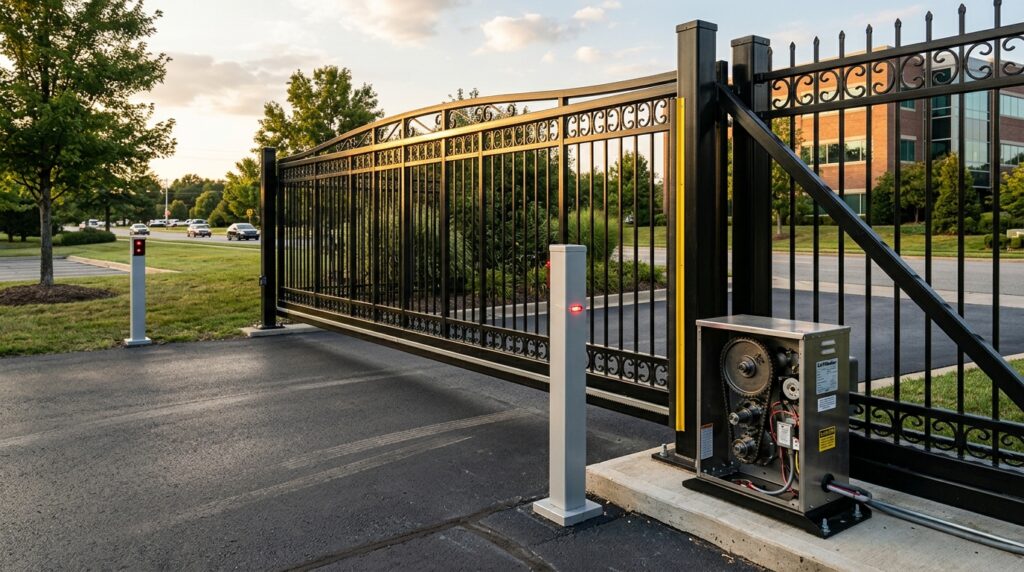
Modern commercial gate installations must adhere strictly to the UL 325 7th Edition standards to ensure safety for high-traffic industrial properties. Central to these requirements is the mandate for monitored entrapment protection, which ensures that the gate operator is constantly communicating with its safety sensors. If a photo eye or sensing edge becomes disconnected, damaged, or fails a self-check, the system is designed to immediately cease automatic operation. This fail-safe mechanism prevents the gate from moving when it cannot verify that the path is clear, protecting both vehicles and pedestrians.
Achieving full compliance requires the implementation of dual entrapment protection for every identified risk zone around the gate. This means that an inherent reversing system built into the motor is no longer sufficient on its own for commercial applications. Installers must integrate a secondary, independent device such as non-contact photo eyes or pressure-sensitive edges to provide a redundant layer of safety. By requiring two distinct methods of detection, the standards ensure that if one system fails to identify an obstruction, the second device acts as a critical backup.
Business owners and facility managers should view these hardware requirements as a vital component of their risk management strategy. Beyond the sensors, the standards also dictate the permanent installation of visible warning signs on both sides of the gate structure to alert users of moving parts. Proper adherence to these monitored safety protocols keeps a property in line with building and fire codes while ensuring the long-term reliability of the automated system. Investing in these automatic gate safety sensors during the initial consultation helps avoid costly retrofits and ensures a secure, compliant entry point.
ASTM F2200 Physical Gate Construction Standards
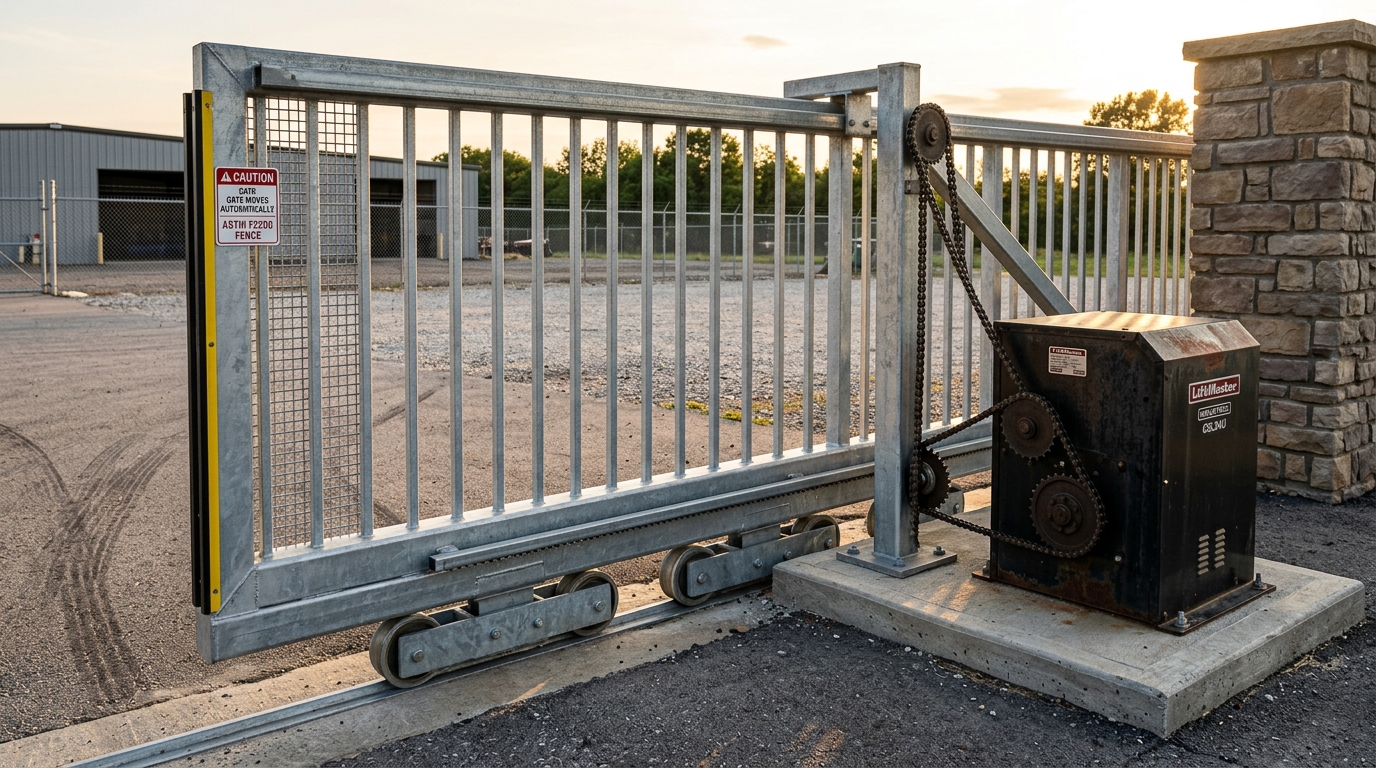
Compliance with ASTM F2200 standards is a fundamental prerequisite for any commercial property owner installing an automated gate system. While UL 325 focuses on the motorized operator, ASTM F2200 dictates the structural integrity and physical design of the gate panel itself to prevent injury. These regulations ensure that the gate is built to withstand industrial use while eliminating potential catch points or crushing hazards. For business owners, adhering to these construction mandates is a critical step in mitigating liability. Professional installers must verify that every physical component meets these specifications before an automated opener is commissioned.
One of the most vital structural requirements involves the spacing of pickets and the smoothness of the gate surface. To prevent entrapment, any openings in a slide gate must be small enough that a four-inch sphere cannot pass through the lower portion of the gate. This design prevents individuals from reaching through the moving structure or getting limbs caught while the system is in motion. Additionally, all gates must be designed with smooth surfaces that lack protruding bolts or sharp edges that could snag clothing. These physical safeguards work in tandem with electronic sensors to provide a comprehensive safety net for high-traffic commercial environments.
The installation of physical travel stops is another mandatory requirement that prevents the gate from over-traveling its intended path. These stops must be robust enough to halt the gate even if the motor fails to stop, ensuring the panel does not fall or slide out of its tracks. For swinging gates, the design must also account for the clearance between the gate and stationary objects to avoid pinch points. Proper guarding must be installed on all weight-bearing rollers and guide wheels to protect hands and fingers. By prioritizing these structural mandates during the fabrication phase, property managers can ensure their automated systems are functional and fully compliant with safety codes.
Commercial Usage Classes And Hardware Specifications
Understanding the distinction between Class II and Class III installations is essential for selecting a system that can handle the specific demands of your property. Class II installations are typically designed for commercial locations like apartment complexes or gated communities where the gate serves a general public audience. In contrast, Class III installations are reserved for industrial settings such as warehouses, factories, or loading docks where access is limited to authorized personnel. Selecting an operator that matches these specific usage classes ensures that the internal motor and gear assembly are rated for the expected cycle count. Professional-grade hardware must be able to withstand hundreds of daily operations without overheating or experiencing premature mechanical failure.
High-traffic commercial environments demand hardware specifications that go far beyond standard residential equipment. Durable components such as heavy-duty steel chassis, reinforced gearboxes, and high-quality bearings are necessary to support the weight of industrial gates while maintaining consistent speed. You must also consider the site-specific power requirements, as many commercial operators require three-phase power to provide the necessary torque for oversized gate panels. Integrating these robust hardware standards with monitored entrapment protection ensures your facility remains compliant with UL 325 and ASTM F2200 regulations. Investing in industrial-grade specifications from the start prevents downtime and ensures a safer environment for both vehicles and pedestrians.
Ensuring Compliance with Commercial Safety Standards
Adhering to modern commercial gate opener requirements is a fundamental responsibility for any business owner investing in perimeter security. By ensuring your system aligns with UL 325 and ASTM F2200 standards, you create a reliable environment that prioritizes the safety of employees, vendors, and visitors. These regulations are critical benchmarks designed to prevent mechanical failure and injury. Moving forward with a compliant installation protects your company from legal liability and potential insurance complications. A gate that meets these rigorous specifications serves as a professional asset rather than a hidden risk.
Maintaining high standards for hardware and safety sensors also guarantees better operational longevity for high-traffic entry points. Systems equipped with monitored entrapment protection and dual safety devices are engineered to handle the constant cycles of an industrial property without frequent downtime. When every component functions within the established legal framework, you reduce the likelihood of emergency repairs and system malfunctions. This proactive approach to compliance ensures that your investment remains durable and efficient. Ultimately, a professional consultation can help bridge the gap between electric gate repair knowledge and a fully optimized, code-compliant security solution.
Frequently Asked Questions
1. What are the primary safety standards for commercial gate openers?
Commercial gate installations must comply with UL 325 and ASTM F2200 standards. These regulations dictate specific safety protocols for entrapment protection and physical gate construction to prevent accidents and liability.
2. What is monitored entrapment protection?
This is a safety feature where the gate operator constantly communicates with its sensors to ensure they are functioning correctly. If a sensor like a photo eye fails its self-check or becomes disconnected, the system will immediately stop automatic operation to prevent injury.
3. Are built-in motor reversing systems enough for compliance?
No, an inherent reversing system is no longer sufficient on its own for commercial applications. You must integrate a secondary, independent device such as non-contact photo eyes or pressure-sensitive edges to provide redundant protection for every risk zone.
4. What happens if my gate system fails to meet UL 325 standards?
Non-compliant systems expose your facility to risks, including fines and mechanical failures. Most importantly, failing to meet these benchmarks creates a safety hazard and leaves your property vulnerable to legal liability.
5. How many entrapment protection devices do I need?
You must implement dual entrapment protection for every identified risk zone around the gate. This requires a combination of the motor’s internal systems and external monitored devices to ensure the gate stops if any obstruction is detected.
6. Do these requirements apply to high-traffic industrial properties?
Yes, these standards are especially critical for high-traffic areas where the risk of interaction with pedestrians and vehicles is higher. Following the UL 325 7th Edition standards ensures your automated system remains functional and secure under heavy use. Many managers often ask how long do electric gate openers last when subjected to these rigorous commercial demands.
7. Why is ASTM F2200 important for gate construction?
While UL 325 focuses on the motor and sensors, ASTM F2200 governs the physical construction of the gate itself. Following these guidelines ensures the gate is built to handle the mechanical stresses of automation without becoming a physical hazard. As technology advances, unified entry security will continue to integrate these physical standards with digital access controls.