
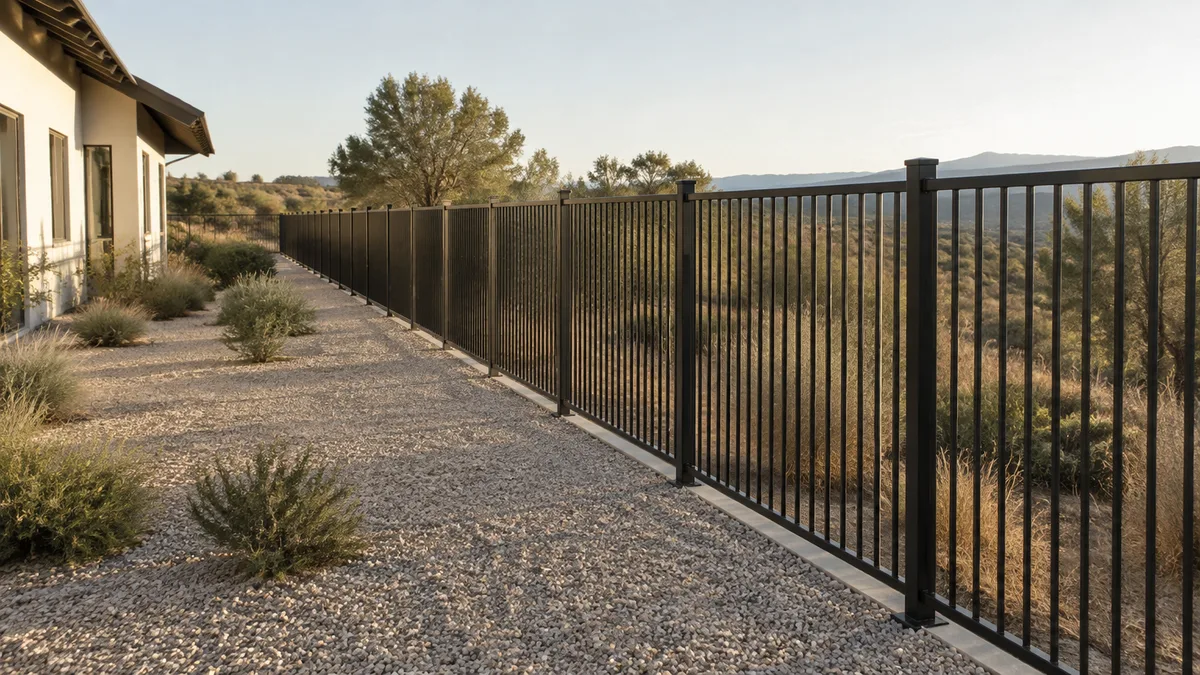
Fences & gates
Fire-resistant fencing can reduce the chance that flames travel from nearby fuels toward a building. Noncombustible metal or masonry is generally a better choice close to the structure. Fire-resistant fencing is not a wildfire-proof barrier: nearby mulch and vegetation, wind, fence design, and the fence’s connection to the house all affect fire exposure.
In California, Zone 0 means the first 0–5 feet around a structure. CAL FIRE advises replacing combustible fences, gates, and arbors attached to a home with noncombustible alternatives in that area. The California Board of Forestry says the Zone 0 regulation remains under final review, so current guidance and rulemaking are not the same. Choosing a fence means weighing fire behavior alongside privacy, appearance, access, and your property’s needs.
Key Takeaways
- Fire-resistant fencing can reduce one path for flames to reach a building, but no fence makes a property wildfire-proof; nearby fuels, wind, fence design, and attachment to the home also affect exposure.
- California Zone 0 covers the first 0–5 feet around a structure, where attached combustible fences, gates, and arbors should be replaced with noncombustible alternatives; the state regulation remains under final review.
- Metal or masonry is generally preferable near a fire-exposed building, but the complete fence assembly and specific product matter; check manufacturer fire information and whether a product appears in the California Wildland Urban Interface Listed Products Handbook.
- Fence layout and nearby fuels matter: closely spaced combustible fence sections and ground fuels can interact, so the area around a fence should be part of the plan.
- Project costs depend on scope and site conditions; we recommend sharing a marked site photo with a licensed contractor to plan materials, gates, and access.
What Does Fire-Resistant Fencing Do?
Fire-resistant fencing uses materials such as metal or masonry near a building to make it less likely that the fence will carry flames toward the structure. It can reduce one route of fire exposure, but no fence makes a property wildfire-proof.
“Fire-resistant” describes an approach to reducing ignition and flame spread, not a promise that a fence will remain untouched in a wildfire. Heat, wind-driven embers, and nearby burning materials can still expose a fence and the buildings around it. The practical goal is to avoid giving fire an easy, continuous path toward a home.
A combustible fence attached directly to a building can connect outdoor fuels to the structure. If the fence ignites, flames may travel along it to the connection point, bringing fire close to siding, doors, or other parts of the building. A noncombustible section near the structure can interrupt that route, though it cannot eliminate other ways fire may reach the property.
The fence material is only one part of the risk. Dry leaves or other debris caught at the base, combustible mulch beside the fence, and nearby vegetation can provide fuel. The fence’s placement and attachment to the building also affect whether flames have a direct route. Fence layout and porosity can influence how flames and embers move, so material choice alone cannot determine how a particular installation will perform.
Which Fence Materials Suit Fire-Prone Properties?
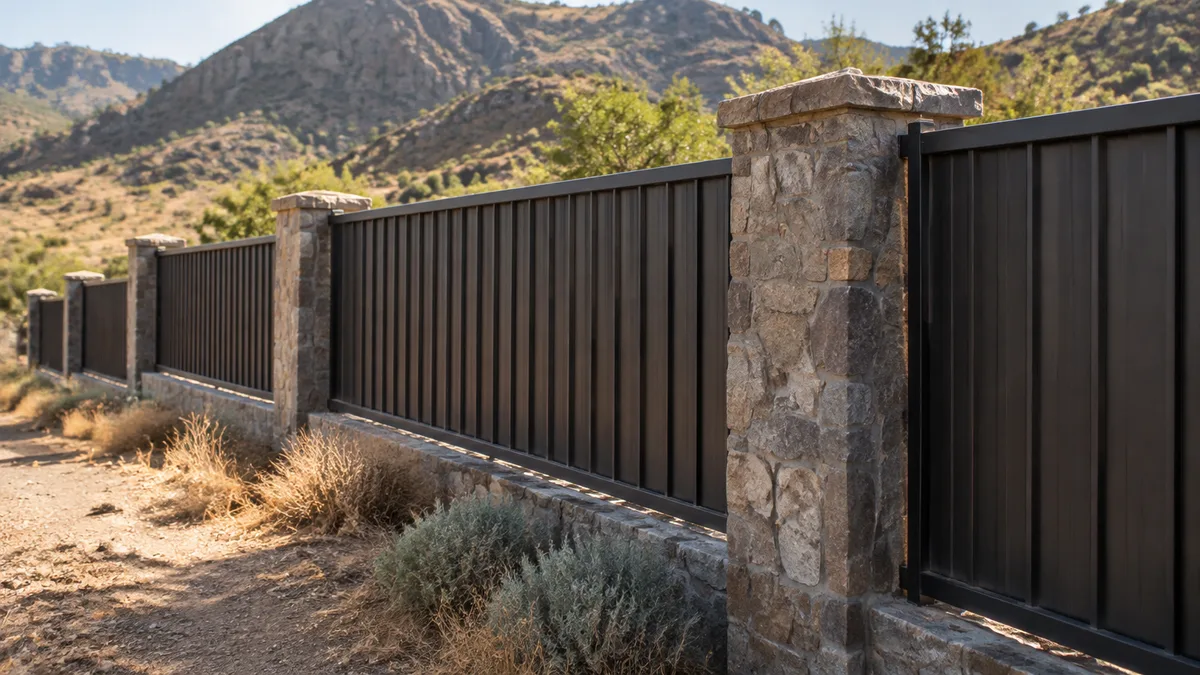
Metal or masonry fencing is generally the most suitable choice when limiting combustible fence material near a fire-exposed building is the priority. Wood, vinyl, and composite can suit different privacy and design goals, but their fire behavior requires product-specific review.
At All County Fence and Gate, we install wrought iron and chain link, along with custom wood and vinyl fencing. Wrought iron can provide a decorative, open look, while chain link offers a practical boundary with visibility through it. Neither provides the same visual screening as a solid privacy fence unless additional screening is used. Masonry can create a solid, noncombustible boundary, but its weight and foundation needs make it a different type of installation from a typical fence.
Wood can provide substantial privacy and a natural appearance, but it is combustible and generally needs more ongoing care than metal or masonry. Vinyl and composite products should not be treated as interchangeable: their ingredients, construction, and fire-related properties can differ. A product name or material category alone does not establish how a complete fence will perform. Check the manufacturer’s fire information for the specific product, including its panels, posts, and other components.
The California Office of the State Fire Marshal maintains a Wildland Urban Interface Listed Products Handbook. It includes products reviewed for compliance with California Building Code Chapter 7A through the Building Materials Listing Program. Check whether a specific product is listed and what the listing covers rather than assuming every product made from a particular material qualifies.
The right choice depends on the property’s exposure, desired privacy, appearance, maintenance preferences, and fit with existing landscaping. For example, an open metal fence may preserve sightlines beside a driveway, while a wood or manufactured privacy fence may better screen a yard. A masonry boundary may suit a plan that already uses hard surfaces, but transitions to gates and adjoining fence sections need attention. We can incorporate custom fencing and automated gates into broader property improvements, allowing us to consider the fence material and layout alongside the driveway and outdoor living features.
How Does Fence Design Affect Fire Spread?
Fence design affects how embers and flames interact with the fence and nearby fuels, so material, construction, spacing, and surroundings all matter. Solid privacy fences can catch embers and provide a continuous surface for flames to travel along.
A wildfire retrofit guide recommends replacing or separating the five feet of combustible fence nearest a home. It also notes that privacy fences with planks on one side of horizontal supports can be more vulnerable to ember ignition than more porous designs. Gaps may change how embers move, but they do not make a fence fireproof.
A field study included 187 experiments involving fences, mulch, combinations of both, parallel fences, and long-range firebrands. In one experiment, two privacy fences 18 inches apart over mulch were engulfed in flames in less than four minutes. That result shows how closely spaced combustible fences and ground fuels can interact; it does not mean every similar layout will behave the same way.
Porous fencing can also affect firebrands in different ways. The U.S. Forest Service found that porous fencing reduced firebrand impingement on homes by up to 35% under some modeled conditions, but could increase impingement under others. Wind speed, fence height, and distance from the firebrand source influenced the modeled outcomes, so openness alone is not a reliable measure of safety.
When planning a layout, consider the fence’s distance from the house, nearby mulch, dry leaves and other debris, spacing between fence sections, and wind exposure. For example, an open metal section near a building may interrupt a combustible fence line, while combustible mulch or trapped leaves nearby can still add fuel. Keep the space around the fence clear of debris, and consider how gates, adjoining sections, and landscaping might create a continuous route for flames.
What Does California Zone 0 Guidance Say?
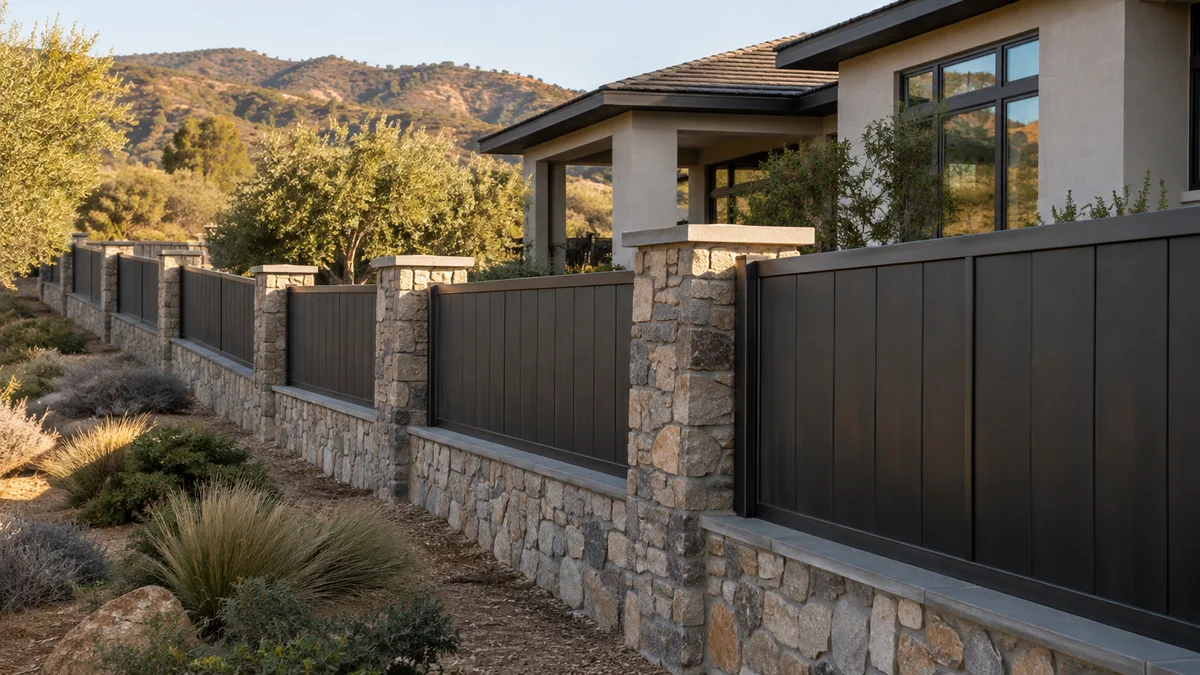
California Zone 0 guidance focuses on the first 0–5 feet around a structure and favors noncombustible materials for attached fences, gates, and arbors, while the state regulation remains under review. AB 3074 (2020) and SB 504 (2024) directed California to establish an ember-resistant zone in that area. The regulation is still under final review by the Office of Administrative Law. The legislative direction and agency guidance are not the same as a finalized regulation. Attached gates and arbors can also be part of a combustible run, so consider the full connection to the structure. The transition point between a combustible fence and a noncombustible section is a practical layout decision. The Insurance Institute for Business & Home Safety’s updated Wildfire Prepared Home Technical Standard, released June 17, 2025, also includes a 0–5-foot noncombustible zone. That standard is a separate technical framework, not California’s regulation. When planning a custom fence and automated gate, identify which components fall within the first five feet and review the applicable guidance and product information before choosing materials.
What Should Fire-Resistant Fencing Cost?
Fire-resistant fencing costs vary with the project scope, material, and site. Published figures provide context, but they are not interchangeable bids.
An IBHS–Headwaters Economics model for a 1,750-square-foot home estimated a Fall 2025 materials budget of $1,106 for a Zone 0 package with wood fencing and cedar bark mulch, compared with $3,742 for a package with metal fencing and gravel. Those amounts cover the full package, not the fence alone.
California’s 2026 Assessors’ Handbook Section 534 lists $22.07 per linear foot for six-foot, 11-gauge steel chain-link fencing in its rural building-cost schedule. That schedule figure is not the same as an installed price for a custom project. In the San Diego area, general installed-price figures are $2,000–$5,000 for typical Zone 0 fence replacement projects and $2,000–$2,500 for partial aluminum replacement without a gate.
These figures describe different scopes and locations, so they cannot be compared as though they were bids for the same work. A project quote needs to reflect the actual fence line and site. Fence length and material affect the amount of fencing and the components required; removing an existing fence, uneven terrain, and gates can add work. Related site work, such as changes to a driveway or adjoining hardscape, may also affect the installation plan and quote.
Planning a Custom Fence and Gate
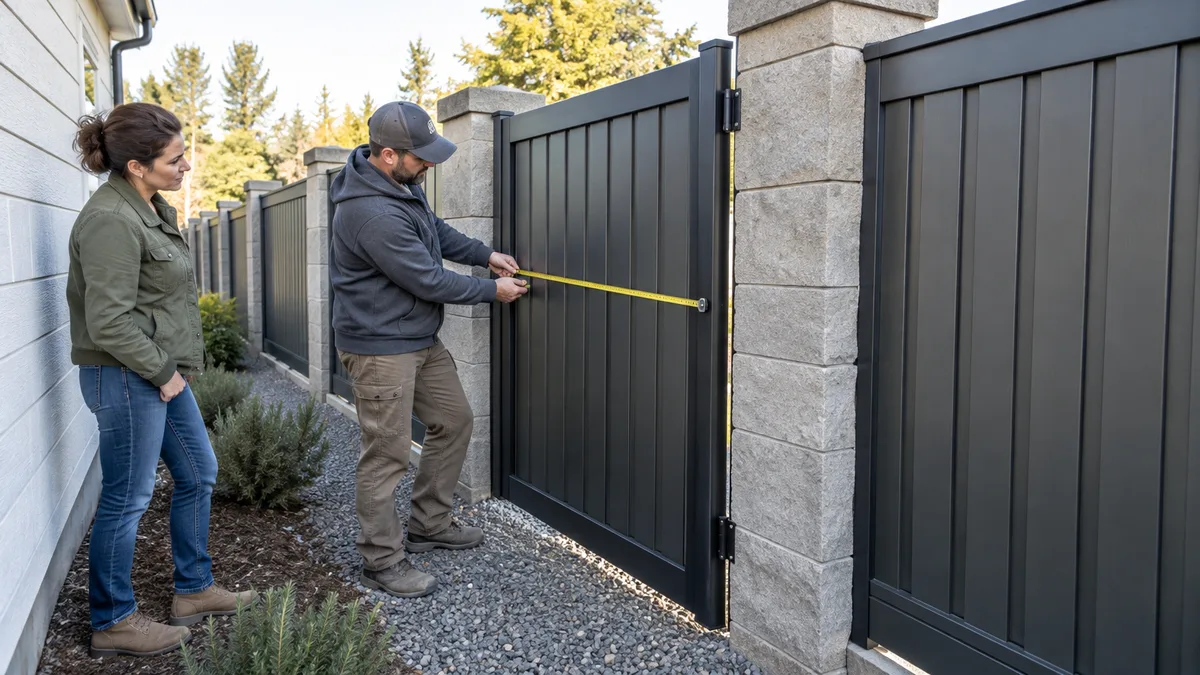
Before choosing a material, map the fence’s distance from the home, nearby vegetation and mulch, your privacy needs, and likely gate locations. Note where the fence meets the house, driveway, yard, or an existing wall; those junctions can affect material transitions and access.
Compare open and solid designs against your screening needs. Wrought iron or chain link may suit a driveway where visibility matters, while custom wood or vinyl can provide more visual privacy. Identify where people and vehicles need to pass, and consider how the gate opening will work with the approach and everyday circulation.
Plan an automated electric gate as part of the full fence layout, not as a separate afterthought. Coordinate its position with adjoining fence sections, pedestrian access, and driveway construction so the boundary functions as one system.
All County Fence and Gate, Inc. is a licensed contractor serving the greater Los Angeles area. We install custom wood, wrought iron, vinyl, and chain link fencing and automated electric gates. Our integrated property-improvement services include hardscaping, pool remodeling, decks, patios, retaining walls, and driveway construction. We invite you to discuss a project-specific solution that brings the fence, gate, and surrounding site work together.
Choose a Fence That Fits Your Property
Start with a site photo showing the house, fence line, driveway, gates, and nearby planting. Mark the sections that connect to the building, the areas where privacy matters most, and the places where people or vehicles need access. If you want a solid screen, note where an open metal section could fit near the house without blocking the view or gate approach.
For a driveway with frequent vehicle access, include the opening width and the space available for an automated gate. If your project also changes a patio, retaining wall, or driveway, mark those areas too. Coordinating the work can help the fence, gate, and hardscape fit together.
Share the marked photo and your priorities with a licensed contractor before choosing a material or layout. All County Fence and Gate, Inc. serves the greater Los Angeles area with custom wood, wrought iron, vinyl, and chain link fencing, automated electric gates, and related outdoor improvements. We can discuss a project-specific plan that accounts for access, appearance, and the surrounding property. Contact us to talk through your fence or gate project and identify the next steps for a custom installation.
Frequently Asked Questions
1. Can fire-retardant paint make an existing wood fence suitable near a home?
Fire-retardant paint does not make a wood fence noncombustible. For combustible fencing attached to a home in Zone 0, replacing it with a noncombustible alternative is the recommended approach rather than relying on a coating.
2. Can I add privacy slats to a metal fence without affecting fire resistance?
Adding combustible privacy slats means the finished fence should not be treated as entirely noncombustible. In the first five feet around a home, consider the materials in the complete fence assembly, including screening, and favor noncombustible alternatives for attached fencing.
3. What is the most durable fencing for a fire-prone property?
There is no single most durable fence for every property, and durability is not the same as fire resistance. Metal or masonry can suit areas where noncombustible materials are the priority, while wood offers a different look and generally needs more ongoing care. Your site, layout, and maintenance preferences also matter.